

SEO Guides, Tips & More!
Learn from Our Experience
How to Get SEO Scores Right
Scores in an SEO audit or tool don’t guarantee ranking. Chasing scores like they will is a damaging practice.
Of course, they are helpful to some degree. But they need to be used correctly. Each tool uses scores with different weights, signals, and thresholds. Scores can also seem either more or less important than they actually are for their ranking value. So, to get the most out of SEO tools, it’s important to understand how scores work.
In Summary
Balancing Immediate Feedback with Strategic Depth: SEO scores offer a proactive way to gauge site health before pushing updates, serving as a vital communication bridge for non-technical teams. However, relying solely on these numbers risks oversimplification. True success requires looking beyond the green to make sure optimization actually aligns with search intent and business goals.
How Chasing a Perfect SEO Score Can Backfire: Gamifying optimization metrics often leads to homogenized content that lacks nuance or unique brand voice. Because every tool weights ranking factors differently, treating a checklist as a golden formula is a mistake. High scores are hollow if they fail to improve organic visibility or ignore the specific structural needs of different page types.
Context Provides the Lens: Effective strategy uses automated metrics to identify broad patterns and prioritize technical fixes across thousands of pages. These numbers should function as a compass to maintain direction, but they must always correlate with actual growth. If a perfect score doesn’t result in more traffic, the metrics likely don’t reflect what users truly value.
It’s Crucial to Get Scores Right…
..and Google agrees. In a Google lightning talk about technical audits, Martin Splitt, a developer advocate, noted that “reports with arbitrary scores or limits on numbers are quite hard to interpret.” Splitt urges viewers “please, please don’t follow your tools blindly.” SEO audit reports, WordPress plugins, and other tools use scores that are hard to understand without context or documentation.
Despite the lack of clarity many face with SEO scores, they are a staple as they are the most immediate feedback before pushing an update out. Other metrics such as behavior signals or organic traffic show after problems have already started. In other words, scores are crucial for a proactive SEO approach.
And it’s not just that. Sometimes marketers take unimportant scores seriously and ignore important ones. In the end, time and resources are wasted over marginal benefit. They may waste resources chasing marginal improvements that boost a score but fail to impact actual search visibility. Conversely, marketers may panic over a sudden dip in a score, interpreting it as an urgent issue when it actually reflects a change in the scoring algorithm.
But scores aren’t useless to SEO either. They do offer benefits that make them worthy of using:
Communication to Non-SEO People
Firstly, scores are useful because SEO’s effort can seem largely invisible. Traffic growth is the number one indicator of value, but increases in scores can tell a story about the fruit of SEO efforts. They abstract the measuring of various site and content quality metrics into numbers that can increase and reflect a real effort in the site.
Yoast SEO is an example of a WordPress plugin that provides SEO scores with traffic light colors and warnings.

The AIOSEO WP plugin provides a list of binary scores to note what could be improved and an overall 100 pt. score.
When progress is visually obvious, anybody can tell what the SEO problems are on a given page, because the problems look like a bright red icon or a low number. And when they’re fixed, an all-green checklist is very satisfying to look at. For writers, scores both inform and incentivize better-optimized content. Beyond content writing, other teams can also get a read on a website’s SEO without needing the expertise on hand.
Easy for Benchmarks
Setting an objective is easier with SEO scores. It’s hard to magically know what metrics reflect on the user experience and how to track them from the technical side. Getting a number to quantify and easily direct SEO strategy streamlines the process. For example, anybody can pop into Lighthouse and plug in their website. And there are multiple accessible ways to improve a site with Lighthouse.
Google’s Lighthouse reports are a great example as they use some of Google’s own ranking factors.

The Lighthouse report embodies what makes ideal benchmarks: a group of simple numbers that are easy to measure and improve upon. Lighthouse offers ranges for good/bad scores and provides an overall out of 100 rank. While there are more things that influence search engine rankings, getting the Lighthouse performance to green is an easy goal to set. And SEO experts know that what Lighthouse measures drives a real impact.
Largest Contentful Paint, Cumulative Layout Shift, and First Contentful Paint are Core Web Vitals, which are factors considered to be a necessary baseline. If a website doesn’t have a good overall score among these factors, it can suffer in rankings from poor performance. This happens both organically as visitors get frustrated with load times and user experiences and as enforced by Google moving the page down the list.
Immediate SEO Feedback
Scores provide much quicker feedback compared to traffic increases, which can take time to materialize. Changes can be iterated on a page many times until scores look good, all before an update is pushed out. The actual benefits SEO brings are a bit too far away to reasonably iterate upon, so the guessing that scores do is helpful.
Several SEO tools such as Surfer SEO analyze content in real-time as its being written and update the score accordingly.

Surfer SEO Content Editor dashboard.
The content dashboard provides an overall score that updates as articles are being written. Surfer SEO and similar tools are useful because they make it an immediate process that happens alongside writing content. Immediate feedback is especially powerful because it is perceived more positively and is largely more impactful than delayed feedback. Like a compass, SEO scores keep writers, designers, and developers on the right track with less room to unintentionally steer into bad practice. This is how optimization is generally meant to be applied. SEO avoids being a checklist after the fact, and the draft leaves production with SEO approval
A positive side-effect is that SEO is more integrated into the earlier stages of production. Search intent is best placed at the front of the process, especially if it ties search intent directly with business goals. A streamlined workflow will reduce the time taken to rewrite content to fit SEO measures.
Simplifying Data
When there are hundreds of things to account for, a limited set of data points becomes useful for not getting lost in the sauce. Scores can effectively set priorities ahead of time when a tool chooses to include some metrics and exclude others. An example here is how Ahrefs Site Audit offers percentages. These percentages reflect how many URLs have errors and what kind of errors they are with the ability to individually check.

An Ahrefs audit highlights a percentage of links and gives percentages without having to manually check.
The Ahrefs Site Audit illustrates simplifying well. Many data points from thousands of pages get abstracted into simple scores that give an immediate, overall diagnosis of how a site is doing. Ahrefs divides issues into Errors, Warnings, or Notices, highlighting which things are most broken and therefore likely need attention. Ahrefs even offers a “top issues” tab to provide the priority for its users.
This approach helps the user decide which things to tackle first which, in other words, automates priorities. Users can instead spend their time focusing solely on what has been marked important. Having a priority set on website issues is the crucial because there will always be something that’s still optimizable.
Of course, SEO scores aren’t perfect. There are several problems to watch out for when using them. So understanding their limitations is crucial for getting the most out of SEO tools:
Varied Weighting
As mentioned in the beginning, scores are weighted differently across tools. All-encompassing scores like AIOSEO’s TruSEO score or Rank Math’s SEO score are difficult to usefully interpret as different ranking factors are chosen as more or less important.

AIOSEO’s TruSEO score appears as a small number next to a headline score.
Unfortunately, no one plugin or audit has a golden formula that best predicts what search engines want. Unless Google’s entire algorithm leaks, SEO will remain to be a series of well-educated guesses that reflect what Google tells/appears to prioritize.
On the other hand, it’s hard to tell what matters when scores are placed on equal footing. AIOSEO, for instance, provides a flat list of things to fix in a WordPress post. In a vacuum, these traffic-light scores appear equally important and seem like getting all green will guarantee results. But this checklist mentality does not bear out as a viable SEO strategy. SEO is best treated as a marketing channel that should be integrated into the processes that produce content and develop the website.
Oversimplification
The flip-side of the simplifying advantage is that it reduces nuance and complexity. See the above example, where AIOSEO takes all of the good and bad of a page and summarizes it with a score for the headline and a score for the rest of the page’s SEO. Truly quality SEO involves understanding the purpose of a website and the business model behind it; plenty of high-ranking sites have some scores in the yellow or red.
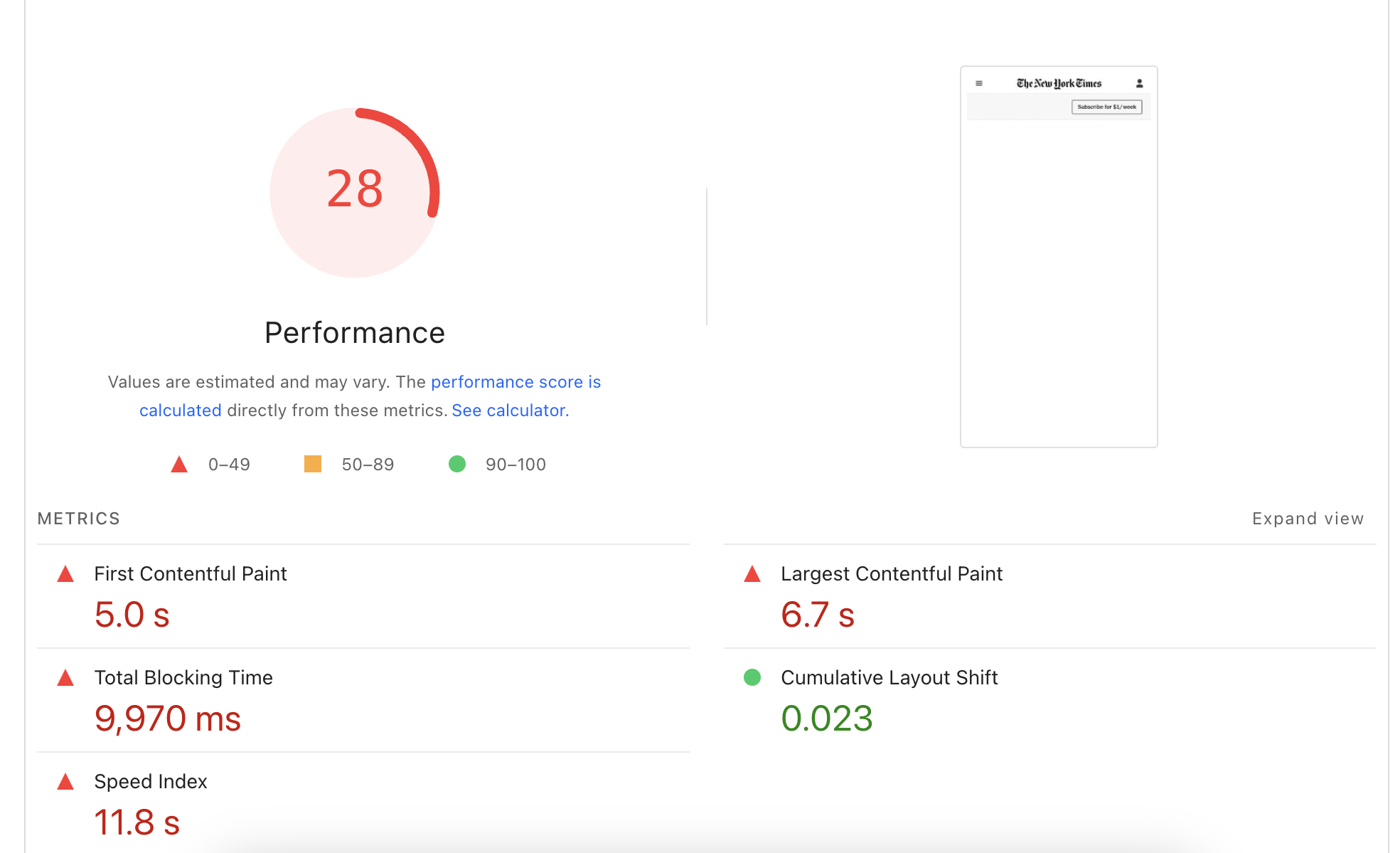
News sites such as that of The New York Times do not require good performance for the mobile site, as NYT prioritize a separate phone app for interested mobile users.
Using the same example, a headline score could be low while not ultimately mattering if clients or users already frequently visit a well-known brand and appreciate catchy headlines. NYT or BBC articles wouldn’t need to worry much about headline scores because they are established and don’t need to rank to reach the top. Their priority is instead the impact of headlines so that articles get clicks when they appear.
What’s more, simplifying can conceal important variance between pages or sections. Pages on a website don’t all follow the exact same structure. A page detailing a product or service should be short-length, but evergreen content should be long. Structured data is far more important on an E-commerce page than it is on a blog post. Yet, scores will be given to pages regardless, such as in the case of WordPress SEO plugins.
Gaming the Metric
Turning SEO into a game of scores is useful for motivation as it provides a visible, immediate target and a guide for how to improve metrics towards said target. Given the previously mentioned problems, though, chasing SEO scores can lead to problems.
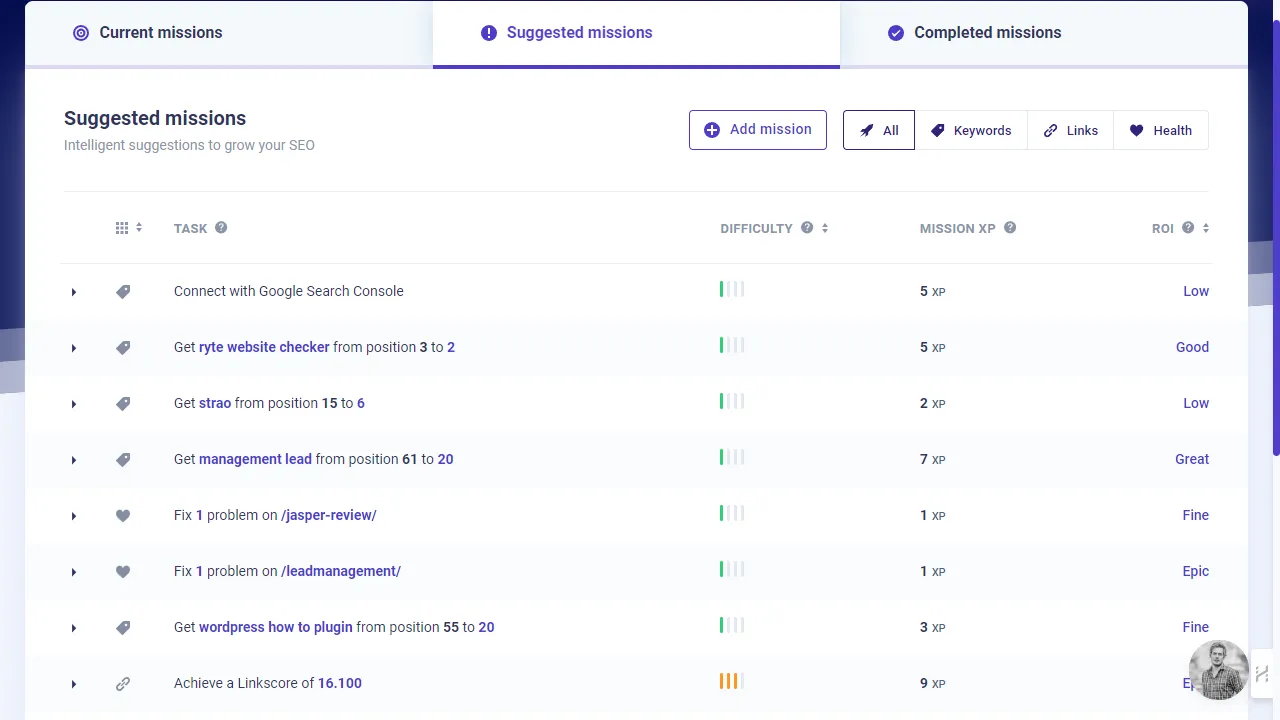
Morningscore offers an SEO tool with missions—tasks such as increasing rank or fixing problems on a page—that give XP. This is a strong example of gamified SEO scores.
Gamification creates a focus on compliance to a tool’s algorithm while ignoring the value of things like human voice and context. This leads to articles getting homogenized to the formatting deemed optimal by SEO tools where short, business neutral writing is prioritized. Other arbitrary restrictions sometimes appear as well. Yoast, for instance, suggests that a heading needs to break up text every 300 words. While breaking up text can help content flow better, there are more ways than just headings.
Gamifying scores also create a ceiling, where a ‘high enough’ or perfect score makes a page seem like no further gains are possible. This takes out the depth required to tackle Google’s algorithm, especially in the age of AI. In the same way that early SEO sometimes tried to rank by spamming keywords and backlinks, content and strategy that chases scores degrades the quality of the content and website.
While listing a number of problems with scores may make them sound bad or zero-sum, the truth is that they do point to real problems websites have. The individual situation of a website and/or business needs to be applied for the scores to mean anything. It’s up to the person reading them to judge whether a red or low number truly matters. Given that, the specific way to apply context to scores is a process to learn in and of itself.
So how are SEO scores actually useful to SEO experts and those outside of the industry?
How to Use SEO Scores
First, SEO scores are best used like a loose guide. Scores indicate general patterns and act like a baseline that should be met for most pages on a website. Revisiting Lighthouse factors, Google indeed uses Core Web Vitals to indicate page experience. Score drops do not necessarily mean that something is urgently wrong with a website. Rather, a long-term drop below the ideal score may indicate a structural problem whose fixing would have a tangible SEO benefit. In the case of Lighthouse this would mean scoring below 90 or 80 on something like performance. This is especially the case if any of the metrics plummet and stay down.
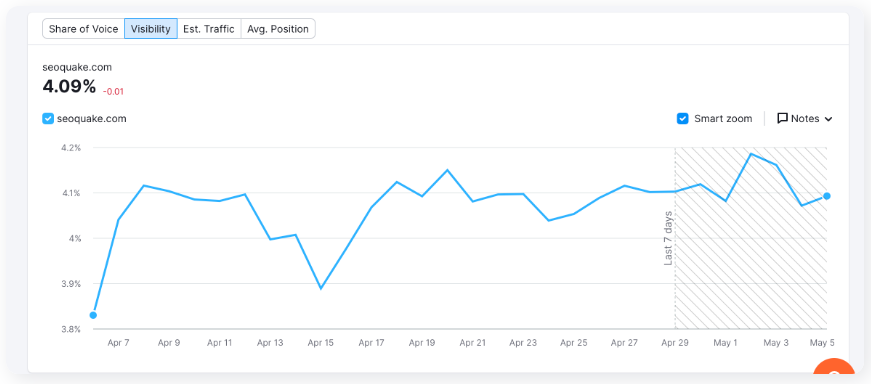
Semrush sample overview of visibility percentage. This score is calculated from a website’s appearance in top 100 results.
As previously mentioned, SEO scores have the advantage of being a communicable element for non-SEO teams. This is part of their intended use. They can be used either to bring attention to something that needs fixing or to quickly demonstrate success without slower indicators like organic traffic. In either case, the final point is that scores indicate to non-SEO people what’s going well or poorly.
That same simplicity and clarity also makes SEO scores useful beyond internal reporting. One of these further uses is to compare a website to its competitors, in absence of Google giving data on its ranking decisions. This is where tools like Moz’s Keyword Gap come into play. This particular tool allows users to get an overview of what keywords competitor sites are ranking for and how much traffic can be gained by ranking for those keywords. For websites that aren’t local and/or target a niche, catching up with competitors is a must.

Results from Moz’s Keyword Gap for a suitcase company. Note Traffic Lift, which is a calculation of how much traffic can be gained by ranking higher in a given keyword.
Analyzing competitors builds the foundation from which optimization is made. In other words, it’s important to use competitor rankings to develop a website’s SEO strategy. The exact tactics and keywords differ widely as no niche is made equal. This is not necessarily a topic for SEO scores, and luckily there are plenty of guides out there on how to develop an SEO plan with competitor data.
These competitor-driven insights are even more valuable when they’re managed applied to many pages. However, at that point, it’s impossible to manually check every URL. Therefore, SEO scores are used to take care of that automatically. Regarding automation, some SEO audit tools have scores out of 100 are useful for broad overviews. Semrush has Authority Score, Moz has Domain Authority, and Ahrefs has Domain Rating.

A sample report of an average website from Semrush’s Website Authority Checker. Link Power refers to the quality/quantity of backlinks, and Natural Profile refers to how artificial those backlinks seem.
These scores are good for quickly checking a website or page’s overall SEO hygiene. Semrush’s Authority Score is a good example because a breakdown of what made the score is given upfront. In the report shown above, it’s clear that the website in question has average backlinks and relatively low organic traffic. Building backlinks and increasing visibility through other channels are some of the possible SEO targets from this report.
While SEO scores have several uses, there’s an important caveat: scores need to correlate with actual growth. Improving SEO scores needs to eventually make a noticeable difference in a website’s traffic, otherwise the scores either aren’t tracking important things or the website’s circumstances makes them inapplicable.
As previously mentioned, not all scores are created equal. They have different weights, signals, and thresholds. Google only has one way of ranking pages, and scores either get closer to or farther away from the algorithm. In addition, some metrics and metrics vary too much between individual websites to be meaningful. When this is the case, those scores will be difficult to use for improving SEO.
Regarding individual circumstances, there are several cases where improving SEO scores on a page won’t be useful for growth. Some examples are listed below:
- If a page doesn’t match search intent or the topic lacks search demand, then other imrpovements won’t have much impact across the site. In other words, an impact will only come if the foundation is right. One of Google’s ranking factors is topical authority, so the trustworthiness of page content also matters.
- Traffic shifts happen from other marketing channels, such as an email campaign or a scandal, especially in sites that already rank. Because of that, the history of past events is important for making correlations between SEO and traffic.
- Google’s E-E-A-T framework is far-reaching. Sites with thin content or weak author/brand authority may get little benefit from technical/on-page score gains. This is especially prevalent for YMYL content, which relates to topics like health, finance or law, where low authority content and misinformation are far riskier for the well-being of search engine users.
The list is by no means exhaustive, as ultimately, the utility of scores depends on every individual case. But it does illustrate the need to always look at SEO scores and their usefulness through the lens of the website they are being optimized for. Again, scores are not themselves a goal; tools shouldn’t be blindly followed. SEO tools align with a site’s context to translate to useful guidance.
Conclusion
In summary, scores are indeed a useful tool for SEO. Scores are useful for simplicity, informing others about SEO, setting benchmark targets, and immediate feedback. However, it’s also important to keep in mind that Google’s algorithm is complex, and the scores that try to approximate it are just as complex. The type of websites and its history are important factors in deciding which scores are meaningful and which are not.
Instead of being an arbiter of good and bad SEO, scores are best utilized as a diagnostic tool that points to gaps in a website’s SEO. The best move is to take a look at the user engagement metrics, and see which pages most need improvements and to then consider what will deliver best results. In other words, optimize for the website, not just for the tool’s scores.
Scores are nothing more than a cool number if they don’t translate to results. It’s important to bridge what the tool says is good and what a website and its visitors actually want.
Get in Touch
To understand the complexity of SEO requires care, especially when it comes to using tools. Our experts at Flashpoint Marketing are ready to assist with SEO questions or concerns.
